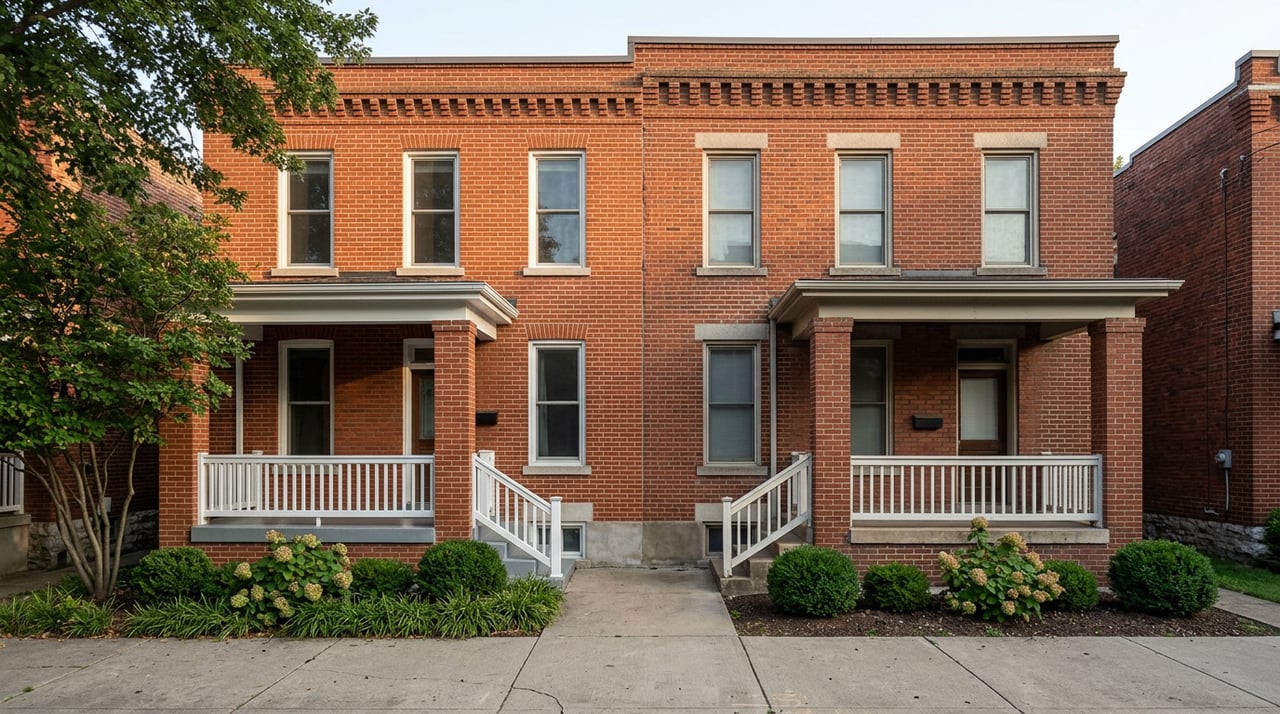
Havertown Twin Sellers: Understanding Shared-Wall Agreements
September 3, 2026
September 3, 2026
A Havertown seller sitting down with the Pennsylvania disclosure form gets through six questions without much trouble. Roof age. Basement moisture. Termites. Then item seven arrives: are you aware of any shared or common areas, such as driveways, bridges, docks, or walls, or any maintenance agreements tied to them, as the Pennsylvania Code asks. For most detached homes in the township, the answer is a quick no and a turn of the page. For the roughly one in seven Haverford Township homes that are twins, it is the question that stalls the whole form, because the honest answer is usually "there's a wall, and no one has ever written anything down about it."
That gap between what the form assumes and what actually exists on paper is the thing worth understanding before you list a Havertown twin, not after a title company flags it three weeks into a contract.
Pennsylvania's Seller's Property Disclosure Statement is built around the state's Real Estate Seller Disclosure Law, and one of its standard items asks sellers to confirm whether the property shares a wall, driveway, or similar feature with a neighbor, and whether any agreement governs it. The form doesn't require you to produce a party wall agreement. It only requires you to say, honestly, whether one exists.
Here is where Havertown's housing stock creates a specific problem. Many of the township's twins, the paired semi-detached homes clustered in sections like Brookline, Bon Air, Westgate Hills, and Chatham Park, went up as matched pairs built and briefly owned in full by a single builder before the two halves were sold off separately. Because one owner held both sides at the moment of construction, there was rarely a reason to draft a formal agreement about who repairs the shared roof bay or repoints the party wall's masonry. The homes have since changed hands three, four, five times, and the paperwork that never existed still doesn't exist.
So when today's seller reaches item seven, the true answer is often "unknown," not because anyone is hiding something, but because nobody in the chain of ownership ever created a document to know it from.
An honest "unknown" on the disclosure form can invite scrutiny at exactly the point in a transaction when sellers want the fewest surprises: after the home inspection, when the buyer's attorney or title company reads the report and notices the shared wall question sitting next to an inspector's note about masonry cracking or roof flashing along that same wall.
At that point, a few things tend to happen. The buyer's side may ask for a written side letter with the neighboring owner, even an informal one, spelling out who's responsible for what going forward. A title company doing its own due diligence may extend the review period to search for any recorded easement or maintenance covenant tied to the property. And if the inspection turns up a real issue at the shared wall, chimney flashing, tuckpointing, or a shared roof valley, that issue can become part of the negotiation in the middle of your contract.
None of this kills a sale. It slows one down, and it hands negotiating leverage to whichever side raises the issue first.
Twin sellers also run into a second kind of friction that has nothing to do with the wall: figuring out what the home is actually worth. Havertown's headline price data has been sending two different signals this summer, and the difference matters more for a twin than it does for a detached colonial.
| Source | Metric | Figure |
|---|---|---|
| Home-value index | Average home value | $553,632, up 4.5% year over year, as of June 2026 |
| Closed-sale data | Median sale price | $545,000, down 3.5% year over year, over the most recent 30-day window this summer |
| Closed-sale data | Price per square foot | $278, down 5.1% year over year, same window |
Both of these numbers are describing Havertown. Neither is wrong. They're measuring different things.
A home-value index estimates what every home in town would sell for right now, based on a model applied to the entire housing stock, whether or not that home actually traded hands. A median sale price only counts homes that closed in the last month, which in a town Havertown's size can be a few dozen transactions. When a small sample shifts toward more twins, more rowhomes, or more homes needing work relative to the month before, the median can drop even if no individual home lost value. The index keeps climbing because it's still modeling the same broad stock. The median dips because the mix of what actually sold changed.
A townwide median blends detached colonials on quarter-acre lots with twins on much smaller footprints sharing a wall. Buyers and appraisers don't treat those as interchangeable, and they shouldn't be priced as if they were. An appraiser working a twin will typically pull other twin sales as comparables rather than blending in detached homes down the street, because the shared wall, the narrower lot, and the attached construction all affect how the property is underwritten.
That means the townwide numbers, in either direction, tell a Havertown twin seller very little about what their specific home will fetch. What matters is the last handful of twin-to-twin sales in a comparable section, not the average across every housing type in the township. Havertown's overall market is still moving fast by conventional measures, homes have recently sold in around 39 days on average with a competitiveness score in the low 70s out of 100, some with multiple offers and waived contingencies, but a hot overall market and a well-priced twin listing are two different achievements. One comes from town-level demand. The other comes from pricing against the right comparables.
A few steps, taken before a buyer's attorney ever sees the file, keep the party wall question from becoming a delay:
What does the disclosure form ask about a party wall agreement? It asks whether an agreement exists. What helps is having a written, even informal, understanding with your neighbor before that question comes up in front of a buyer's attorney.
Will my twin appraise the same as a detached home nearby? Not usually. Appraisers working an attached property typically pull other twin sales as comparables rather than blending in detached colonials, since the shared wall and smaller footprint affect value differently than a standalone lot.
What if my neighbor and I disagree about who pays for a shared repair discovered during my sale? This is exactly the scenario a pre-listing conversation is meant to prevent. If it surfaces mid-contract instead, expect it to become a negotiating point between your attorney and the buyer's, often resolved through a credit or a short delay while the repair scope gets defined in writing.
If you're weighing a sale of a Havertown twin, or trying to figure out what your specific section, Brookline, Bon Air, Chatham Park, or elsewhere, is actually producing in twin-to-twin sales right now, Fizzano Family of Associates REALTORS® can walk through the disclosure paperwork and the comparables together, before either one becomes a surprise. Request a free consultation and home valuation to start that conversation.
This article is general information, not legal, tax or financial advice. Consult a qualified professional about your situation.
Stay up to date on the latest real estate trends.

We all know that the world has changed and Real Estate has as well. If you are contemplating selling or buying, please allow me the opportunity to talk with you about my “Win/Win” Real Estate solution!

FIZZANO FAMILY OF ASSOCIATES REALTORS®
ADDRESS
104 WILTON WOODS LN
MEDIA PA 19063